October 7, 2024
Benefits Of Becoming A Cosmetology Instructor
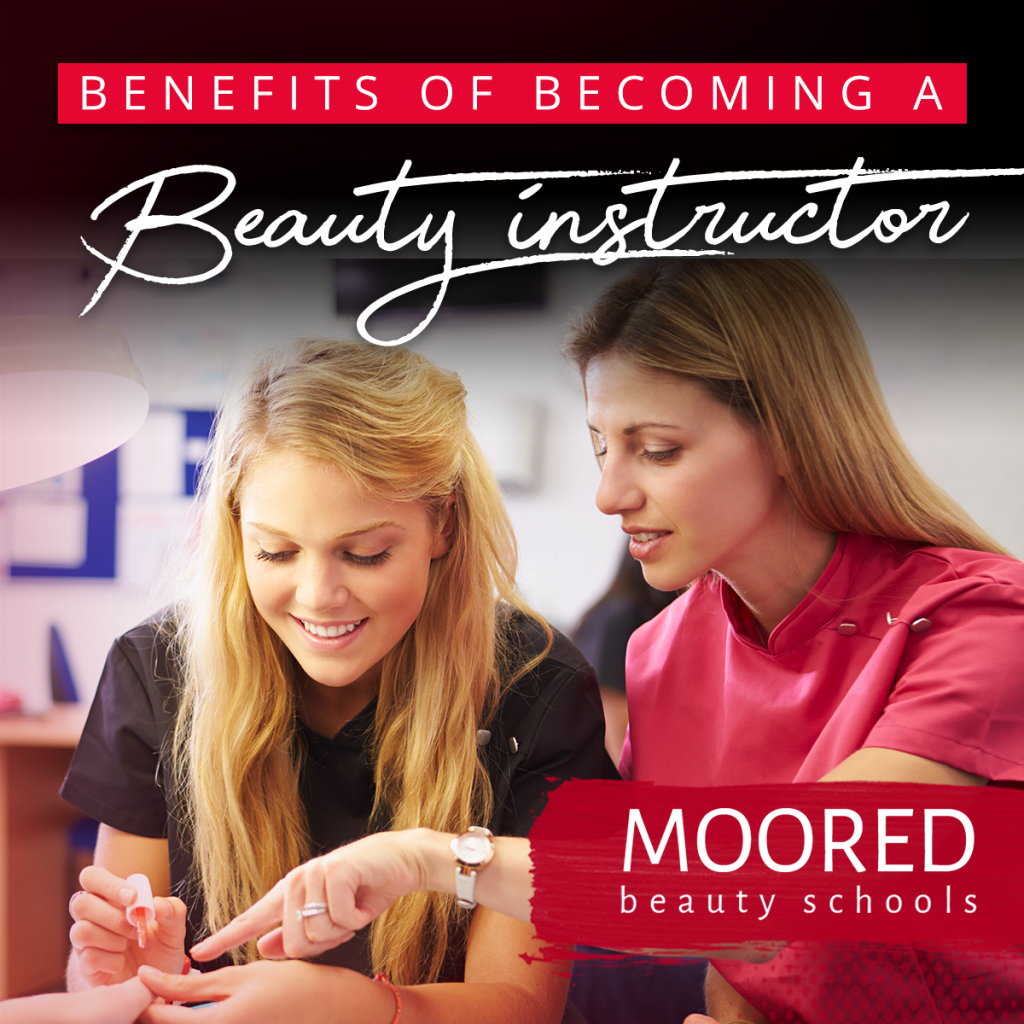
If you’ve spent time working as a cosmetologist and find yourself enjoying the moments when you get to explain a technique, help a newer stylist, or answer someone’s questions, becoming a cosmetology instructor could be a natural next step. Teaching gives you a different way to stay connected to beauty while sharing the experience you’ve built with students who are just getting started.
At Moored Beauty Schools, our Cosmetology Instructor program is designed for licensed cosmetologists who want to build teaching, communication, and classroom skills while working with real cosmetology students. You already know what it’s like to learn the craft. Becoming an instructor gives you the chance to help someone else find their way through it.
Why become a cosmetology instructor?
One of the biggest reasons to become a cosmetology instructor is simple: you get to share what you know. After spending years learning techniques, working with clients, solving problems, and figuring out what works for you behind the chair, teaching gives you a chance to pass some of that experience along.
And there’s a lot more to teaching than demonstrating a haircut or explaining color theory. Students are learning how to communicate with clients, build good habits, handle mistakes, stay organized, and become more comfortable with skills that may feel completely new at first.
If you remember what it was like when you were in beauty school, you probably remember having days when everything clicked and others when it definitely didn’t. An instructor can be the person who helps a student work through both.
For cosmetologists who enjoy encouraging people, answering questions, and watching someone improve, that can be a pretty rewarding way to use the skills they’ve built.
Can becoming an instructor give you a new way to stay involved in beauty?
Yes. Teaching can let you stay close to the beauty industry while using your cosmetology experience in a different way.
You’re still talking about haircutting, color, styling, skincare, nails, sanitation, client communication, and all the other pieces of cosmetology. The difference is that instead of focusing only on your own services, you’re helping students understand how those pieces fit together.
You also get to revisit the fundamentals. When you have to explain why a technique works, break it into steps, or answer a student’s question, you may find yourself thinking about familiar skills in a new way. Beauty keeps changing, too. Products, techniques, trends, and client expectations evolve, so working with students can give you another reason to stay curious and keep learning.
How can teaching help you grow as a communicator?
Being a good cosmetologist and being able to teach cosmetology aren’t exactly the same skill. Instructor education helps you learn how to take something that feels natural to you and explain it to someone who may be doing it for the first time. That takes patience and communication.
One student may understand something as soon as they see a demonstration. Another may need you to explain the steps out loud. Someone else may need to try it, make a mistake, ask a question, and try again. As an instructor, you learn to pay attention to those differences and adjust how you communicate.
Those skills can be useful beyond the classroom, too. Clear communication matters when you’re working with clients, talking with coworkers, mentoring newer cosmetologists, leading a team, or explaining products and techniques.
What’s it like to mentor future cosmetologists?
Mentoring can be one of the most meaningful parts of teaching cosmetology because you get to see students change over time.
A student may walk into class nervous about holding their tools correctly. A few months later, they may be more comfortable talking through a consultation or working through a service they once found intimidating. Sometimes the most helpful thing an instructor can do isn’t give a perfect demonstration. It’s reminding a student that learning takes practice, helping them understand what went wrong, and giving them another chance to work through it.
You also have your own salon experiences to draw from. Maybe you’ve dealt with a difficult consultation, fixed a mistake, learned how important sanitation really is, or figured out how to manage your time on a packed day. Those real experiences can help give classroom lessons more context. You’re not just teaching from a textbook. You’re bringing the perspective of someone who has actually worked in the industry.
Do cosmetology instructors still get hands-on experience?
Instructor training can still be very hands-on. At Moored Beauty Schools, Cosmetology Instructor students work with real cosmetology students while learning how to teach, communicate, demonstrate techniques, and manage a classroom environment. That matters because teaching is something you get better at by doing.
You can learn about instructional techniques in a lesson, but it feels different when a real student asks a question you weren’t expecting. You might need to explain a concept another way, demonstrate a step again, or figure out how to help someone who’s frustrated.
Moored uses a mix of lectures, demonstrations, and hands-on training in the Cosmetology Instructor program. The goal is to help you learn how to teach the theory and practice of cosmetology while also developing the work habits, communication skills, and teaching techniques that can matter in the classroom.
What do you learn in a cosmetology instructor program?
Cosmetology instructor training focuses on how to teach the skills and knowledge you already began building as a cosmetologist. At Moored Beauty Schools, that can include:
- Teaching techniques: learning different ways to explain and demonstrate cosmetology concepts.
- Classroom communication: practicing how to give instructions, answer questions, and provide useful feedback.
- Teaching aids: learning how materials such as texts, workbooks, demonstrations, and visual resources can support a lesson.
- Cosmetology theory and practice: strengthening your ability to teach the technical knowledge students need to learn.
- Working with students: learning how to guide different personalities and learning styles in a classroom setting.
- Professional habits: helping students understand the attitudes, communication, and work habits that matter in beauty school and the industry.
It can be an interesting shift. You’re no longer asking only, “Can I do this?” You start asking, “Can I explain this clearly enough that someone else can learn how to do it?”
Can you teach and still work behind the chair?
You may be able to make both teaching and salon work part of your professional life. Some cosmetology instructors teach full time, while others continue working with clients and teach on a different schedule. That can be appealing if you love the classroom but aren’t ready to give up salon work.
Continuing to work with clients can also keep you connected to everyday salon experiences. You’re still seeing what clients are asking for, working through consultations, using products, and dealing with the kinds of situations your students may eventually experience themselves.
Other instructors may decide that education is where they want to spend most of their time. Your interests can change as you gain teaching experience. There isn’t one version of what being a cosmetology instructor has to look like.
Where else can teaching experience take you?
A classroom is the most obvious place to use a cosmetology instructor license, but teaching skills can also be useful in other parts of the beauty industry.
Depending on the role, your experience, and any additional qualifications that may be required, you could become interested in areas such as:
- Cosmetology school instruction
- Student mentoring
- Curriculum development
- Beauty brand education
- Product demonstrations
- Salon education
- Industry events and classes
- Training or mentoring other beauty professionals
You may discover that you love standing in front of a classroom. Or you may find that teaching opens your eyes to another part of the beauty industry you hadn’t really thought about before.
What should you know before becoming a cosmetology instructor?
Before you enroll, make sure you understand the requirements for the state where you plan to become licensed as an instructor.
For example, Michigan requires cosmetology instructor applicants to hold a Michigan cosmetologist license, have a high school diploma or equivalent, complete the required instructor education, and sit for the theory exam. For anyone beginning instructor training on or after July 1, 2024, Michigan requires at least 600 hours of instructor training.
A full Michigan cosmetology instructor license also requires at least three years of practical experience in hair care services, natural hair cultivation, skincare services, and manicuring services, with at least one year in a cosmetology establishment.
If you’re thinking about teaching in Michigan, it’s a good idea to review the latest details through the Michigan Board of Cosmetology. You can find current licensing information there when you’re ready to take that step.
Moored Beauty Schools’ Cosmetology Instructor program is offered by invitation only and has its own enrollment requirements. If you’re not sure whether you’re ready yet, that’s a great question to bring to our team.
How flexible is the Cosmetology Instructor program at Moored?
We know that many people looking at instructor education are already licensed cosmetologists with jobs, clients, families, and full schedules. That’s why having options can matter.
Moored Beauty Schools offers morning, afternoon, and evening scheduling options for the Cosmetology Instructor program. The program is available at our five campuses across Michigan and Indiana.
Program length depends on the state. Michigan’s program is 600 hours and can be completed in as little as three months. Indiana’s program is 1,000 hours and can be completed in as little as six months.
Your actual timeline can depend on your schedule, attendance, and progress through the required hours, so talk with our Admissions & Enrollment team about the campus and schedule you’re considering.
How do you know if becoming a cosmetology instructor is right for you?
You don’t have to be the loudest person in the room or someone who has always dreamed of being a teacher. A better question is whether you enjoy helping other people learn.
You might enjoy instructor education if:
- You like showing coworkers how you do something
- You’re patient when someone needs to hear an explanation more than once
- You enjoy seeing other people improve
- You like talking about the why behind a technique, not just doing it
- You want to stay involved in cosmetology in a new way
- You’re curious about mentoring or education
- You have real-world experience you’d like to share
If a few of those sound like you, it may be worth looking more closely at what teaching involves.
You’ve already spent time learning your craft. Instructor education gives you the chance to learn something different: how to help someone else build theirs.
Why explore instructor education at Moored Beauty Schools?
At Moored Beauty Schools, you won’t only talk about teaching. You’ll have opportunities to work with cosmetology students and practice the communication, demonstrations, and classroom skills that go along with being an instructor.
You’ll also be learning from instructors who understand what it’s like to stand on both sides of the classroom.
Our Cosmetology Instructor program is built around the theory and practice of cosmetology, teaching techniques, communication, good work habits, and hands-on experience with students. It’s a chance to take the knowledge you’ve gained through your own beauty education and industry experience and learn how to share it with someone who’s just beginning.
If you’ve caught yourself thinking, “I’d actually love to teach this,” take a closer look at the Moored Beauty Schools Cosmetology Instructor program. You can also talk with our team about the requirements, available schedules, and whether instructor education could make sense for you.
Frequently asked questions
What are the benefits of becoming a cosmetology instructor?
Becoming a cosmetology instructor can give you a new way to share your beauty experience, mentor students, strengthen your communication skills, stay connected to cosmetology, and explore education-related opportunities within the beauty industry.
Can a cosmetology instructor still work as a cosmetologist?
Yes. Some instructors continue working with salon clients while they teach, while others choose to focus more of their time on education. Your schedule and the requirements of your job can help determine what works for you.
How many hours is cosmetology instructor training at Moored Beauty Schools?
The Moored Beauty Schools Cosmetology Instructor program is 600 hours in Michigan and 1,000 hours in Indiana. The Michigan program can be completed in as little as three months, while the Indiana program can be completed in as little as six months.
Do you need to be a licensed cosmetologist to enroll in the Cosmetology Instructor program?
Yes. Moored Beauty Schools requires Cosmetology Instructor students to have a valid, current cosmetologist license. The program is also offered by invitation only and has additional enrollment requirements.
What do you learn in cosmetology instructor school?
Cosmetology Instructor students at Moored Beauty Schools can learn the theory and practice of cosmetology, teaching techniques, the use of teaching aids, classroom communication, and how to work with cosmetology students in a classroom setting.
Where does Moored Beauty Schools offer the Cosmetology Instructor program?
Moored Beauty Schools offers the Cosmetology Instructor program through five campuses in Michigan and Indiana: Twin City Beauty College, Traverse City Beauty College, Tulip City Beauty College, Nuvo College of Cosmetology, and Michiana Beauty College.
Leave a Reply